Improving the Odds for Children by Asking Better Questions

In the introduction to How Children Succeed: Grit, Curiosity and the Hidden Power of Character, Paul Tough frames the problem of improving the lot of poor children:

“We haven’t managed to solve these problems [how early experiences connect to adult outcomes] because we’ve been looking for solutions in the wrong places. If we want to improve the odds for children in general, and for poor children in particular, we need to approach childhood anew, to start over with some fundamental questions about how parents affect their children; how human skills develop; how character is formed.” (xxiv)

The answer those questions is that childhood – and early childhood in particular – is the apprenticeship of being human. Character is formed and skills are developed in the context of relationships – which is why the impact of parents in those early years is so profound.

There is another line of questions that needs to be pushed farther than Paul Tough ventured.

  1. Is it possible that qualities and skills that enable “success” in contemporary society may be acquired, and yet the person be bereft of real virtue?
  2. How can we cultivate in children the kind of virtue that enables them to persevere in pursuit of the good even, and especially, when pursuing the good means losing rather than winning? (Think of Martin Luther King Jr. receiving death threats and persevering until he was assassinated.)

These are the kinds of questions we must ask if we are serious not just about getting kids through high school, but about the pursuit of real virtue and flourishing communities.

“I don’t want you to end up like me.”

Over the next few weeks, I will be blogging through Paul Tough’s book How Children Succeed: Grit, Curiosity and the Hidden Power of Character. It is packed full of insight into the role that families and communities play in forming children, and the role that supporting organizations can play in those families in communities. Paul’s first book, Whatever it Takes: Geoffrey Canada’s Quest to Change Harlem and America sparked my interest in apprenticeship as a compelling metaphor to describe what happens in every family and home during the earliest years of life. How Children Succeed contains many overlapping themes with The Apprenticeship of Being Human, and is worthy reading for anyone who cares about education, inequality and social flourishing.

The Breaking Point

Paul tells the story of Kewauna, who was arrested at age 15 for striking a police officer. Kewauna’s mother sat her daughter down and said to her, “I don’t want you to end up like me.” For Kewauna, that conversation was the beginning of change. It took her mother’s radical honesty about her own history to help her change course. (In one year, her GPA changed from 1.8 to 3.4.)

In the weeks and months to come, I will argue that this kind of honesty is essential to breaking cycles of poverty. Only when parents can honestly say, “I don’t want you to end up like me,” can there be an honest dialogue about responsibility and possibility. Kewauna’s mom was ruthlessly honest and humble. Her courage made possible her daughter’s transformation. That is beautiful, praiseworthy and revolutionary.

What is more valuable than self-control?

Over the past year, I have volunteered to help with the chess club at my daughter’s elementary school. The students participate for an hour in a club that includes direct instruction in rules and strategies of chess, and lots of time to play the game.

One day I played chess with “Andrew,” and was struck by his inability to control himself. He interrupted the coaches, bothered the other students, and didn’t think through his moves carefully. I could only imagine how he behaved in the classroom during the school day.

Is there any skill more valuable for an 8 year old than self-control?

In Paul Tough’s new book How Children Succeed: Grit, Curiosity and the Hidden Power of Character, he argues that character traits and social skills (in which he specifically includes self-control) are more important than cognitive skills for children to thrive.

In chess club, that is certainly true. If you have self-control, you can listen attentively to the rules and strategies. You can wait patiently for an opportunity to put your opponent in checkmate. You can keep your cool even when your opponent has the upper hand in the game. Indeed, you can lose again and again – and learn from it to become a good player in all the senses of that word. It is no overstatement to say that self-control is a pivotal virtue that catalyzes learning, relationships, and human development.

Can you think of a more critical virtue for an eight year old?

What Children Really Need is Character

The New York Times Motherlode recently carried a post titled What Children Really Need for ‘Back to School.’ It a sentence, what children really need is character, because their character shapes how they will manage all of the challenges they face: at home, in the classroom, and in their vocations. Character is the primary factor that determines the joy or pain that they will bring to parents, teachers, colleagues and neighbors.

Children (and adults) build character by forming habits. Bad habits form bad character. Good habits form good character. Arthur Levine and Diane Dean highlight the bad habits of parents bailing out their children, overpraising them, and failing to teach them responsibility. Bad habits bear bad fruit in parents and children alike.

The beginning of a school year is a great time to ask hard questions:

  1. What are my bad habits that are forming bad character in myself and my children?
  2. What are the habits that we need to focus on and form in the next week, month, and year?
  3. What are the virtues that I most want to form in my children? What family routines and habit can help them to form those virtues?

The Remedy for the Opportunity Gap

In a July 9, 2012 Op-ed titled The Opportunity Gap, New York Times columnist David Brooks identifies and laments that “children of the more affluent and less affluent are raised in starkly different ways and have different opportunities” – opening up an even greater chasm in society that threatens the social fabric.

Brooks wisely notes that while money plays a significant role, there is a huge gap in the time that parents of different educational levels invest in their children, and that the marriage gap plays a huge role in the time available to invest in children. He recognizes that the earliest years are the critical gap: “This attention gap is largest in the first three years of life when it is most important.”

Brooks offers two prescriptions for the opportunity gap: liberals need to insist that marriage comes before childbearing; and conservatives need to be willing to pay (in increased taxes or reduced benefits) for “programs that benefit the working class.”

There is another, more radical, prescription. It is for advantaged parents to build personal relationships with, and support, disadvantaged parents – especially in that critical period of early childhood.This approach has a host of benefits: (1) it doesn’t engage in blind finger pointing at either the “out of touch elites” or the “morally inferior underclass”, (2) cultural transmission of important values happens relationally rather than merely programmatically, and (3) perhaps most obviously it bridges widening social gaps by bringing people with very different experiences together – physically and relationally.

I have no illusions that this is easy. It isn’t; it is very hard work. But think about it this way: If you were poor or working class, who would you listen to? Policy pundits who say to get married before you have kids and enroll in government programs that address your issues, or real people who help you change diapers, listen to your story, and join you in reading books with your children? I can tell you whom I would trust more . . .

Parents influence social mobility – by age 3

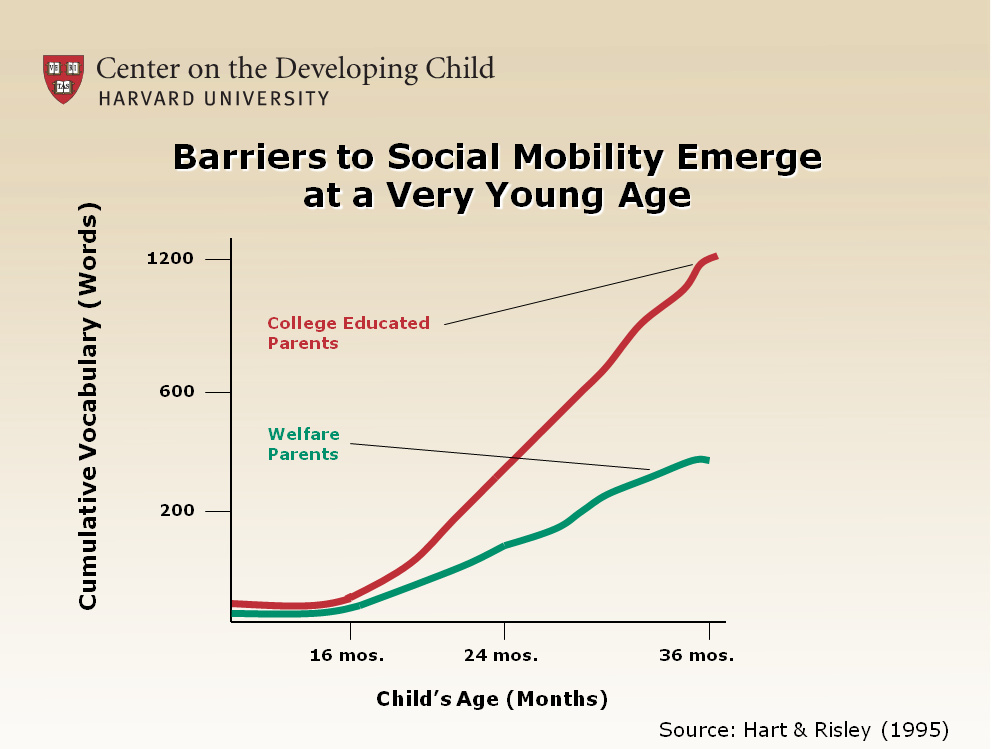
If a picture is worth a thousand words, this one is worth two thousand:

The effect of environment on language development is staggering. A child’s early experience of language produces measurable differences in cognitive ability by 9 months of age and significant disparities in language (and, by consequence, social and cognitive development) by age 3, as evidenced in the graph above.

Illegitimacy: The New Normal

Aside

The New York Times has noted that normal has changed. According to a report from Child Trends, more than half of children born to women under age 30 are born outside of marriage. The article begins: “It used to be called illegitimacy. Now it is the new normal.”

Not just “normal”, but new norms

What has changed is not simply the prevalence of children born apart from marriage, but the norms on which the institution of marriage was grounded. The reason that illegitimacy is no longer used is that it belongs to a time when marriage was not only normal, it was normative for procreation.

If you read the Times  article as an anthropologist, you will be struck by the way that norms have changed over the period of time that has experienced such an explosion of children born apart from marriage. Yes, of course, marriage as a social norm has decayed. But to focus on that is to miss the forest for the trees. What is taken as normative by the journalists – and many if not most of their readers – is that individual and social behavior ought to be explained by efficient causes: changes in the social milieu (e.g. “Liberal analysts argue that shrinking paychecks have thinned the ranks of marriageable men”) and public policy (e.g. “conservatives often say that the sexual revolution reduced the incentive to wed and that safety net programs discourage marriage”). It is now both normal and normative in public discourse to address – and attempt to resolve – social issues exclusively in terms of efficient causes.

The Compounding Effect
My generation is a unique one because we can remember a time when public discourse was not merely in terms of cause and effect, but of right and wrong. Dr. King’s letter from a Birmingham Jail argued powerfully for obedience to just laws and loving disobedience to unjust ones not because such actions were likely to produce desirable outcomes (Dr. King was writing from jail), but because the justice or injustice of a law was measured by its harmony with the moral law, or the law of God. Our children’s generation is in a profoundly different position because their experience of the use of language NOW establishes what they experience as normal and normative. If they listen to us, they stand in danger of seeing marriage merely as a social convention among some subcultures that is merely the product of social, political, and historical (efficient) causes and without any sort of relationship to a moral law or law of God.

Manipulation or Moral Courage
Being born out of marriage is the new normal (at least for children born to women under 30). That’s true whether we like it or not. The question now is how we will respond. Will we try to manipulate the levers of society (public policy, social factors, etc.)? Will we argue about what carrots and what sticks to use to manipulate others into behaviors we desire? Will we blame one another and accidents of history for the state of society?

Or will we have the moral courage to transgress the new norms of language? Rather than blaming others, or impersonal causes, or “social conditions,” will we have courage to take responsibility and confess our own culpability? Will we have the love and patience to come alongside shattered children, mothers and fathers? On what grounds will we call them to something better? Will we recognize that we and they are responsible moral agents who act within the web of real and powerful social settings which do not sufficiently explain our actions? Will we act against social, political, and historical forces for something that is more good, true and beautiful?

Our children are watching and listening.
Inheritance of Hope podcasts

A few years ago, I had the privilege of interviewing Deric and Kristen Milligan for two podcasts. I was reminded recently of the importance of what they do, and that these audio tracks need to be replayed.

Supporting Struggling Families with Deric Milligan
The founder of Inheritance of Hope helps listeners understand how to care for families enduring terminal illness.

Talking to Kids about Death with Kristen Milligan
The author of A Train’s Rust, A Toymaker’s Love (a mother of three, who has a rare form of cancer) shares personal experiences on using literature to talk with kids about mortality.

The Rediscovery of Character and The Heretical Imperative

In a New York Times op-ed yesterday, David Brooks highlighted the legacy of James Q. Wilson. Brooks argues that Wilson should be remembered not just for his “broken windows” theory on how to reduce crime, but for his emphasis on the importance of character for social well-being.

“At root,” Wilson wrote in 1985 in The Public Interest, “in almost every area of important concern, we are seeking to induce persons to act virtuously, whether as schoolchildren, applicants for public assistance, would-be lawbreakers or voters and public officials.

Character is formed, necessarily, in community; and therefore the beliefs, values, and habits of the community are of utmost importance. That truth makes our current situation all the more disturbing. Peter Berger, a sociologist, has described our time as being constrained by “the heretical imperative.” We are commanded to choose our own values, beliefs, and religion. The normative structures that were passed down from generation to generation through tradition (meaning ‘to hand down’ or ‘to hand over’) are now challenged. The new norm is to choose your own.

The rediscovery of character as important is important. However, it is only the first step. Wilson was raised in a nation and generation that had a rich an stable tradition handed down to it. Our children desperately need a rich, robust tradition that tells them virtue is a norm to which they must conform – not one which they may define as they so please. Our children will be bear the fruit of our character, as they are apprenticed to us in discerning and cultivating virtue.

French Parenting and Apprenticeship

NPR recently interviewed Pamela Druckerman, the author of Bringing up Bebe, on her observations of the uniqueness of French styles of parenting, and particularly what contributes to content, well-adjusted kids.

“We [Americans] assume … a little more that kids have inherent likes and dislikes, whereas the French view on food is the parent must educate their child and that appreciation for different food is something you cultivate over time,” Druckerman says.

One key to this cultivation of tastes appears to be exposure. Druckerman points out that in France, “there is no category of food called kids’ food. Kids and adults, from the start, eat the same thing.”

French parenting, like tiger parenting, helicopter parenting, and free-range parenting, is a mode of apprenticeship. It is initiating children into a way of seeing and experiencing the world. Children learn from their parents continually and implicitly what is normal and what is normative. In France, for example, it is normal for children to eat the same food as their parents, and to entertain themselves without parental supervision and interaction. French parents may or may not give thought to this. Regardless of the level of reflection, their children are apprenticed to them.

That’s why parenting matters, and why there are important lessons to learn from those who assume that their kids will develop a refined palate from trying all kinds of food from the start.