Do the choices of well-educated parents affect the acheivement gap?

It (almost) goes without saying that the choices of poorly educated children have a profound influence on the achievement gap. But do the choices of well-educated parents play any role in the achievement gap? Yes, they do.

Veritas RiffIn a recent podcast interview with Ruth Lopez Turley, Associate Professor of Sociology at Rice University, the Veritas Riff explored exactly that question. The seven minute interview is worthwhile and helpful. In addition, here are some important dynamics not covered in the interview.

  1. Prizing academic achievement above community flourishing is passed from parents to children. Children learn from the lived decisions of their parents what is most important to them.
  2. Parent networks really matter in diverse schools. My eldest daughter has attended two very racially and economically diverse schools. And I can say unequivocally that parent involvement (by educated, creative, entrepreneurial parents) created the tipping point in both schools toward a thriving learning environment for all.
  3. Cultural competence is learned by practice. Children (like mine) in diverse schools learn cultural competence by doing it on a daily basis. In addition to Caucasian, Latino and African American children, my daughter’s classmates from China, Mexico, Togo, Thailand, and Bolivia. Can it make some learning dynamics more challenging? Sure. Do the benefits outweigh the challenges? Without question.
  4. Schools are not the biggest factor in education. The choice of educated parents to invest in diverse skill has a profound impact on those schools. However, it must be noted that classroom education is only one dimension of education. The total learning environment of children matters immensely – the impact of home life and community cannot be overstated.
    1. Early home life matters most. Here’s the rub. If you have diverse schools – in which some children have had a language-rich, supportive home environment, whereas others have had a hostile or neglectful home environment, the achievement gap already exists the day they walk into preschool. All of the children will receive the benefits I’ve listed above, and those Dr. Turley highlights in her interview. But some will have greater capacity to receive – and therefore the gap will persist – as it has at my daughter’ schools. The inter-racial, inter-cultural intermingling must happen long before school begins.

 

Could parenting be more important than schooling?

In the education community, it is almost heretical to say that schools are not the center of education. Sean Reardon of Stanford University is, then, almost a heretic. In a New York Times op-ed titled No Rich Child Left Behind, Reardon states:

It may seem counterintuitive, but schools don’t seem to produce much of the disparity in test scores between high- and low-income students.

In the four days since its publication, the article has garnered 1169 comments (as of this writing) – and that is just on the Times comment platform. Reardon is creating a stir. And well he should.

No Rich Child Left Behind

A child’s early experiences matter tremendously for the rest of a child’s life. Reardon’s argument is that the rich understand this well, and have hyper-invested in their children in the earliest years of life. Consequently, there is not just a gap between the poor and the rest; there is a gap between the rich, the middle class, and the poor.

Why do parents matter?

  1. Parents mold your brain.
    Early experiences shape the physical structure of a child’s brain. Think of it as building the hardware that a child will have – and use – for the rest of her life. Parents who recognize this dynamic and engage in ‘concerted cultivation’ give their children a significant advantage over other children. The classic example of this is the Hart/Risley language study.
    AffirmationProhibition
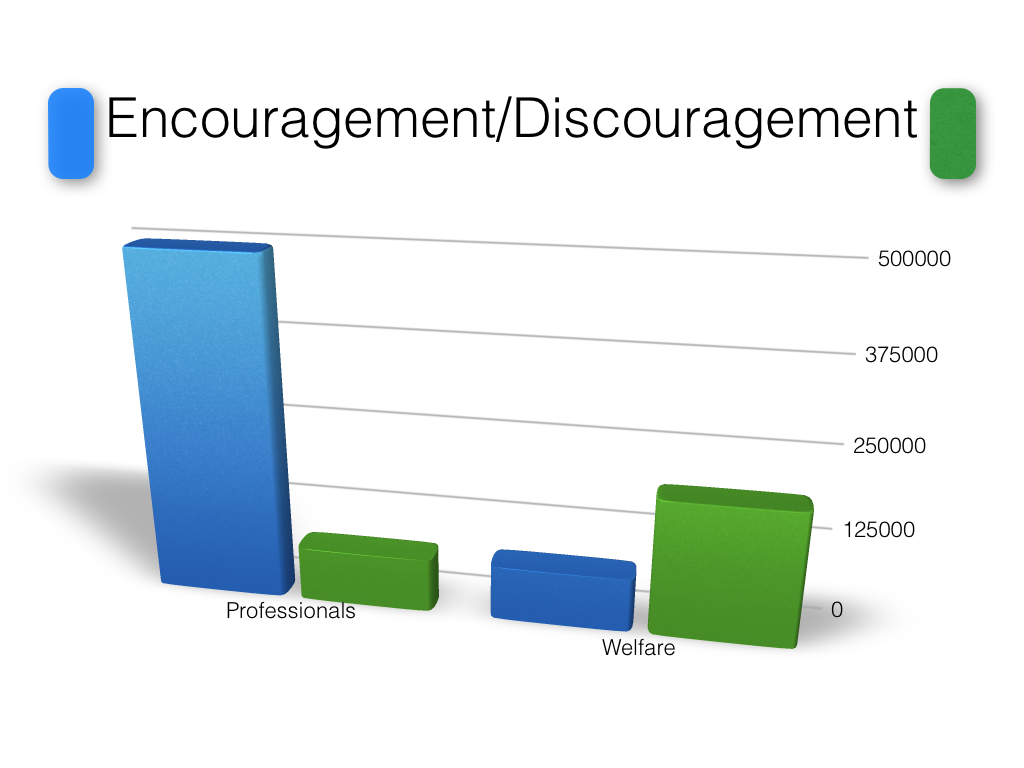
    They counted the number of words children heard in different home environments and estimated that children of professionals would hear 500,000 affirmations by the age of 3, whereas their counterparts whose parents were on welfare would hear only 80,000 affirmations by the same age. The children of professionals would hear 80,000 discouragements; children in families on welfare would hear 200,000 discouragements. It hardly needs to be said that those experiences have lifelong implications.
  2. Parents shape your character.
    Character formation is not distinct from brain development. Early experiences shape a child’s habits – of how to treat others, how to take care of the material world. These habitual actions and postures are character. This is not a sphere in which wealthier children necessarily have privilege. In this sphere, having parents who are wise, just, and loving matters far more than their income or education.
  3. Parents give you opportunities.
    The very concrete opportunities that parents provide are formative. This is most obviously true with language. Young children who hear multiple languages in the home in the earliest years acquire those languages as mother tongues by virtue of the opportunities that their parents created. Is it any wonder that elites enroll their young children in Mandarin classes?

What’s missing?

Reardon has written the best piece on education and parenting that I have seen appear in the Times. It is to be celebrated, discussed, and used to take action. However, there are two dynamics that need more attention than they received in Reardon’s op-ed, one of which I have already mentioned.

  1. The power of networks
    It isn’t just that rich parents provide more and better opportunities for their children to learn. They also create a network of social elites through which their children will have social opportunities that far exceed their peers of like ability and different social strata. That’s why Upper East Side preschools can charge $40,000 per year.
  2. The force of character
    Much more emphasis  needs to be given to the the role that parents have in forming character. Character is both more malleable and more important than intelligence, and wealth is no necessary privilege (it can even be a significant liability) in forming virtue. The character of children of elites matters immensely because they will inherit power and influence. The question is whether they will use it well.

Christian Parenting Handbook Launch: $400 in resources

As an author, I’m always looking for endorsements from public leaders I trust. Scott Turansky is one of those people. I approached him because of the tremendous wisdom I’ve gleaned from books and media that he has written and produced, particularly Parenting is Heart Work and Say Goodbye to Whining, Complaining and Bad Attitudes . . . in You and Your Kids. Scott and his co-author, Joanne Miller, did a fantastic podcast interview on “the break” where I tried to get their wisdom out to a wider audience.

Now I have the opportunity to get more of their resources to a wider audience – at a deep discount.

The Christian Parenting HandbookScott and Joanne are launching a new book this week, and are offering some amazing deals:

  1. $400 in free resources to those who buy the book between April 29 and May 5.
  2. Five Fantastic giveaway items, including an iPad mini.

I’ve written a review on Amazon that details why I recommend the book. I bought the print copy of the book on the first day of their launch, even though I already received an advance copy of the eBook.

Why? I wanted all the other resources that they’re giving away with print purchases. And I love being able to flip through physical books to share with others.

You might be saying to yourself, “Wait a minute. This is The Christian Parenting Handbook, and I’m not a Christian.” That’s a valid concern. But let me encourage you to push past it. You can get the first 5 chapters for free to see what you think. I often commend Scott’s work to people who aren’t Christians. I think his heart-based approach is authentic, compelling, and winsome. More than that, I’ve practiced what he teaches and have reaped the benefits of looking past behavior to the heart, of focusing on character rather than compliance. (If you disagree, let me know why! I’d love to hear it.)

This book is organized into fifty short chapters. You can easily read one chapter in a short time, and have a piece of wisdom on which to take action with your kids. That’s the kind of help I need, so I encourage you to check it out too. Buy it. Get the $400 bonus of resources. And sign up for the giveaway.