Graham Scharf is a father, the husband of a developmental pediatrician, a former NYC Teaching Fellow, and co-founder of Tumblon.com. He has worked in team development, taught in an urban public school, and is full-time dad to his nine- and three-year-old daughters. Graham spends most of his time reading, writing, gardening, and exploring playgrounds, parks, libraries, zoos and museums. He is the author of The Apprenticeship of Being Human: Why Early Childhood Parenting Matters to Everyone.
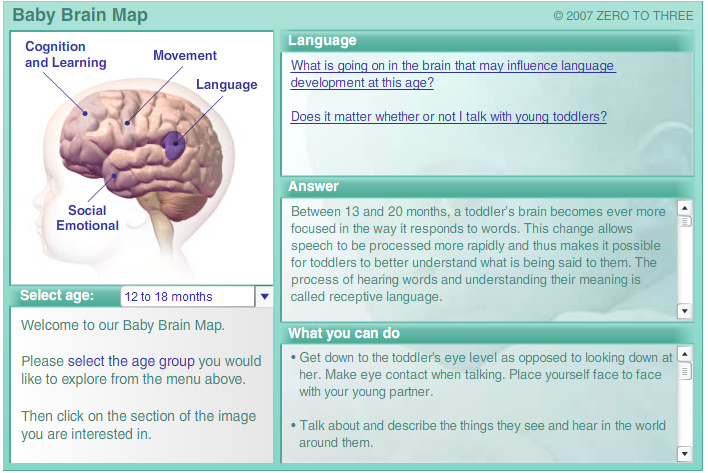
Zero to Three has developed a creative, interactive visual to show what parts of a child’s brain are developing at particular times, and what parents can and do to support healthy development. Â It is a helpful reminder of just how important the early years are.
To try it out, simply click on the image below to go to Zero to Three.
Paul Tough’s recent cover story in the New York Times Magazine titled What if the Key to Success is Failure? makes a strong case for the importance of character in education. With masterful style, he tells how two educational leaders of very different schools have collaborated to help their students develop character.
The article has rightly garnered attention and reaction from major news outlets and influential thinkers. Tough has touched a nerve. He has put into words what others feel.
Paul Tough is the author of Whatever it Takes: Geoffrey Canada’s Quest to Change Harlem and America. The brilliance of that book is the second chapter: Unequal Childhoods (although the whole book is fantastic). In Unequal Childhoods he chronicles the importance of what happens in the home long before children enter school. And he wisely recognizes that perhaps the cornerstone and linchpin of the Harlem Children’s Zone’s success is its Baby College with engages and empowers parents from before birth.
Here is the pressing question: If the earliest years are so critical for brain building that the achievement gap exist long before children enter school, is it possible that the same is true of character? Could it be that a child’s character is significantly formed in this period? Could it be that the formation of character in the earliest years is at the very heart of the education crisis?
In the recent riots in England, many have been asking, “Where are the parents?”
Diane Sawyer asked it in this ABC News clip:
It is a good question, but it doesn’t get to the root of the issue. As this Guardian article points out, the reason that parents don’t restrain their kids is that they long ago lost – or abdicated – their authority.
He warns that too often schools are faced with pupils who have never had any boundaries in their home lives – where there has never been a sense of right and wrong.
“Parents are not willing to say ‘no’. That short, simple word is an important part of any child’s upbringing,” says Mr Lightman, general secretary of the Association of School and College Leaders.
“It’s desperately important that children have a sense of right and wrong. But we often come across children who have never been told that something is wrong.”
Likewise, Prime Minister David Cameron has charged, “There are pockets of our society that are not only broken, but frankly sick.”
Riots take a decade of character formation
How does a pocket of society get to the place of wanton looting? Very slowly.
It takes practice: doing the same thing again and again. Abdicating authority. Refusing to say ‘no.’ Treating children with contempt. Ignoring children. Leaving them to their own devices. If you do these things repeatedly over the course of a decade (or more), you will form the sort of character in a child that says, “We’re doing this to show the police and the rich people that we can do what we want” and that it “is the government’s fault.”
For better (or in this case for worse), children learn from their parents what is normal and normative from the earliest years of life. The question is not just where the parents were over the past week that their children were rampaging on the streets. The question is where they were over the past 10 to 18 years. The answer to that question will point more clearly to the sort of slow, hard solution that is needed.
Has it ever occurred to you that you get washboard abs the same way you get a gut?
Both are attained by practice. What you do repeatedly affects the shape of your body – whether arduous ab workouts, or consuming more calories than your body needs.
What does this have to do with parenting?
It is commonly assumed that practice is the pathway to excellence. It is. But it is also the path to mediocrity and failure. What you practice, and how you practice determine which path you’re on.
Many young children are on the path to having a gut before they even lose their baby teeth. They’re practicing a pattern of nutrition and exercise that will result in obesity in all but a few children. Parents (or those who act in their stead) are the chief influences of early childhood nutrition and exercise. We are the ones who establish patterns of practice – patterns which can lead to health or disease.
The NY Times on Roland Fryer: Toward a Unified Theory of Black America. Stephen J. Dubner provides a fascinating peek into the personal history, talents, and passions of one of the world’s brightest young economists.
Robert Coles on stories: The Call of Stories: Teaching and the Moral Imagination. Pediatric psychiatrist and Harvard professor Robert Coles shares his journey into literature through the poems of physician William Carlos Williams – and of his own journey through literature in teaching graduate students in many disciplines.
This podcast was recorded by Graham Scharf for the Tumblon podcast series. (Click on Balancing Parenting Responsibilities to play the audio in your browser using QuickTime, or “Ctrlâ€+ click and “save as†to download and listen later.)
The Break with Scott Turansky and Joanne Miller
The authors of Parenting is Heart Work highlight a parenting technique that addresses the heart.
This podcast was recorded by Graham Scharf for the Tumblon podcast series. (Click on The Break to play the audio in your browser using QuickTime, or “Ctrlâ€+ click and “save as†to download and listen later.)
Why Marriage Matters with Kay Hymowitz
(Click on the link to play the audio in your browser using QuickTime, or “Ctrlâ€+ click and “save as†to download and listen later.)
The author of Marriage and Caste in America discusses the need for cultural renewal through the family. Hymowitz explores the social implications of the disproportionate decay of marriage in some social groups.