The Rediscovery of Character and The Heretical Imperative

In a New York Times op-ed yesterday, David Brooks highlighted the legacy of James Q. Wilson. Brooks argues that Wilson should be remembered not just for his “broken windows” theory on how to reduce crime, but for his emphasis on the importance of character for social well-being.

“At root,” Wilson wrote in 1985 in The Public Interest, “in almost every area of important concern, we are seeking to induce persons to act virtuously, whether as schoolchildren, applicants for public assistance, would-be lawbreakers or voters and public officials.

Character is formed, necessarily, in community; and therefore the beliefs, values, and habits of the community are of utmost importance. That truth makes our current situation all the more disturbing. Peter Berger, a sociologist, has described our time as being constrained by “the heretical imperative.” We are commanded to choose our own values, beliefs, and religion. The normative structures that were passed down from generation to generation through tradition (meaning ‘to hand down’ or ‘to hand over’) are now challenged. The new norm is to choose your own.

The rediscovery of character as important is important. However, it is only the first step. Wilson was raised in a nation and generation that had a rich an stable tradition handed down to it. Our children desperately need a rich, robust tradition that tells them virtue is a norm to which they must conform – not one which they may define as they so please. Our children will be bear the fruit of our character, as they are apprenticed to us in discerning and cultivating virtue.

French Parenting and Apprenticeship

NPR recently interviewed Pamela Druckerman, the author of Bringing up Bebe, on her observations of the uniqueness of French styles of parenting, and particularly what contributes to content, well-adjusted kids.

“We [Americans] assume … a little more that kids have inherent likes and dislikes, whereas the French view on food is the parent must educate their child and that appreciation for different food is something you cultivate over time,” Druckerman says.

One key to this cultivation of tastes appears to be exposure. Druckerman points out that in France, “there is no category of food called kids’ food. Kids and adults, from the start, eat the same thing.”

French parenting, like tiger parenting, helicopter parenting, and free-range parenting, is a mode of apprenticeship. It is initiating children into a way of seeing and experiencing the world. Children learn from their parents continually and implicitly what is normal and what is normative. In France, for example, it is normal for children to eat the same food as their parents, and to entertain themselves without parental supervision and interaction. French parents may or may not give thought to this. Regardless of the level of reflection, their children are apprenticed to them.

That’s why parenting matters, and why there are important lessons to learn from those who assume that their kids will develop a refined palate from trying all kinds of food from the start.

Jeremy Lin, Character, and Parenting

Jeremy Lin has made me watch basketball again, but not just because he is an amazing athlete. He is a remarkable athlete with a compelling story. I was snagged from the time that I read the first NYTimes article about Lin sleeping on his brother’s couch on the Lower East Side. I’m a New Yorker, but it wasn’t he fact that Lin is now playing for the Knicks that held my attention. It was his character.

I’m not alone. Today, Forbes ran an article on 10 lessons (mostly character lessons) to learn from the latest basketball phenomenon. It highlighted the role that family played in forming Lin’s character – and resulting strong network of relationships that persist from long years of patient, persistent hard work.

Already much has been said about Lin as an Asian-American Christian. Michael Luo penned a piece for the NY Times that captured well why Linsanity spread nearly overnight among the well-educated Christian Asian-American networks (and particularly in NYC). What deserves note is the way that culture is transmitted through Asian-American families, and particularly Asian-American Christian families.

Children in these families are apprenticed in a way of being human that encourages learning, self-discipline, interdependence, patience, and persistence. As a result, there are a shocking number of second-generation immigrants at the most prestigious and rigorous schools in the United States. And now, there is also one who holds the attention of New Yorkers, basketball fans, and a folks who want a hero who has character and not just skills.

Compelling Early Childhood Numbers

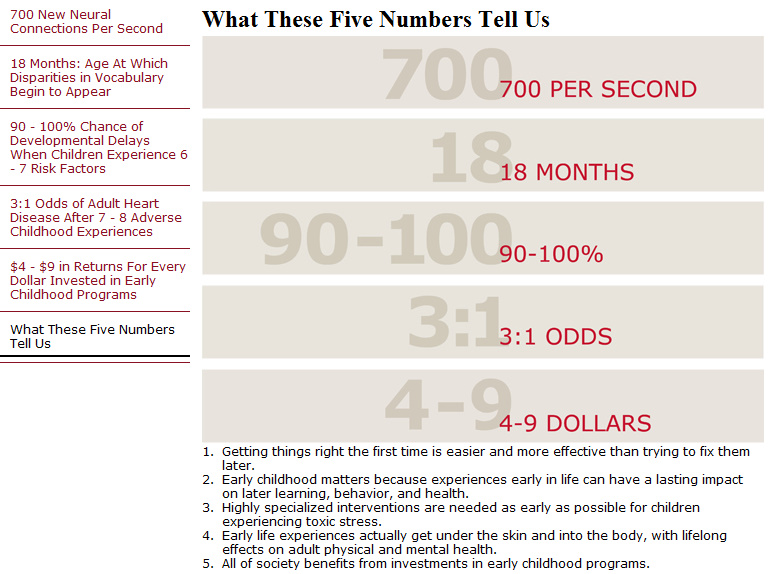
Once again, the Center on the Developing Child at Harvard has provided a great resource for those seeking to understand early childhood. They offer Five Numbers to Remember About Early Childhood Development that are simple, clear and compelling.

The numbers capture well many the most salient numbers:

  1. Rate of Brain Development
  2. Age when Disparities Appear
  3. Impact of Risk Factors
  4. Return on Investment

These are compelling numbers to anyone who cares about health, education, stewardship or civil society.

Early Experiences Alter Gene Expression

The nature vs. nurture argument has long captured the minds of those who care about child development. Which matters more: genetics, or a child’s early environment?

According to Center on the Developing Child at Harvard University, nurture is key. Early experiences alter gene expression and shape development. In an interactive feature on their website, they tell the story of human development and how early experiences leave chemical “signatures” on the genes, which determines whether and how the genes are expressed.

In other words, even with good genes, early experiences can alter the expression of those genes – particularly the ones that affect brain development – in damaging ways. Consequently, “experiences that change the epigenome early in life, when the specialized cells of organs such as the brain, heart, or kidneys are first developing, can have a powerful impact on physical and mental health for a lifetime.”

The question is not nature or nurture. It is how can we support early nurture?

Video: Early Family Experiences Shape Later Success

“There is strong biological evidence, strong neuroscientific evidence that suggest that early family conditions are powerful in shaping cognitive and non-cognitive skills, and that those determine – to a degree that we didn’t realize before – the later success of a person.”

It is for this reason that Nobel Prize winning economist James Heckman lobbies for investment not just in early childhood programs – but in families with young children.

httpv://youtu.be/NCeOBd4Simo

Social Mobility IMPEDES Social Mobility

The New York Times recently carried an article by Jason DeParle titled Harder for Americans to Rise From the Lower Rungs, which highlights the current challenges of social mobility in the United States as compared to other places, and as compared to other times in history in the United States. Angela Glover Blackwell, founder and CEO of PolicyLink, responded with a letter titled Invitation to a Dialogue: Moving Up in America that develops her theme that: ““Movin’ on up” is especially hard for children born poor and black, or poor and female.”

Both DeParle and Blackwell have disturbing data to report. The long and short of it is that children born to parents in the bottom income quintile have poor odds of leaving that income strata. Furthermore, that quintile is over-represented demographically by women and blacks, who are statistically less likely to progress out of that quintile.

Yet both DeParle and Blackwell are shockingly quiet on what seems to be the obvious effect of social mobility. It is that people leave. Social mobility isn’t just about levels of income. It is about where you live, and with whom you choose to associate. Families that seek to leave cyclical poverty often leave communities of poverty to pursue greater opportunities. They move to a place with less crime, better schools, cleaner neighborhoods and more motivated peers; and if they can’t leave, they seek to send their children to schools outside of the community of poverty. The natural, and inevitable, consequence of social mobility is the increasing concentration of poor individuals and families in the communities they leave behind. In short, social mobility is part of the problem for those for whom social mobility is hardest.

This was clear in my experience teaching in Brooklyn in one of those communities in crisis. One of my African-American colleagues, who had taught in that school for 25 years, counseled any parent with the wherewithal to get their children into a different and better school. “No Child Left Behind” made that easier. Since we were a “school in need of improvement,” every parent had the right to request a transfer to a school-not-in-need-of-improvement. The net effect? The parents who wanted a better education and more opportunities for their kids got them into other schools. In other words, we lost the most exemplary parents and their children. Our school became increasingly concentrated with children who had many of the risk-factors for academic failure: father absence, parental drug abuse, poor nutrition, unstable home life, etc.

If we truly care about social mobility for the poorest Americans, we will have to face squarely these issues:

  1. Parent involvement is the single best predictor of a child’s academic achievement, which in turn is a significant factor in social mobility.
  2. Father absence, which is normal in the poorest communities, is a significant risk factor for health, educational attainment, crime, abuse and neglect, substance abuse, and poverty.

In their earliest years, children are apprenticed to their parents in learning to make their way in the world. If we care about their mobility, we need to care for and support their parents.

Serve and Return Interaction Shapes Brain Circuitry

The Harvard Center on the Developing Child has produced a simple video that shows why parent interaction is so critical to early brain development.

httpv://youtu.be/m_5u8-QSh6A

“Ensuring that children have adult care givers who consistently engage in serve and return interaction, beginning in infancy, builds a foundation in the brain for all the learning, behavior and health that follow.”