Practice makes (almost) permanent

The adage goes: Practice makes perfect. That’s true, if you’re practicing the right skill in the right way. More accurately, Practice makes any habit (almost) permanent. Practice can make a flawed habit just a deeply ingrained as a perfect habit.

If you meet an adult who, since early childhood has held forks and spoons in a fist (rather than with three fingers in a pencil-like grip) and ask him to hold his utensils in a standard way, it will feel awkward and difficult to adopt the new hold because years of practice has made his fist-grasp feel normal.

Manners of speech are little different. If you meet an adult who has a verbal habit of using ums and ahs to connect parts of speech, and ask her to speak without those audible pauses, it will feel to her like learning how to speak all over again. By constant practice, she has trained herself to use those sounds without ever thinking about it.

In virtually everything we do, practice makes almost permanent. For this reason, learning early to hold a fork in a particular way, or to speak without ums and ahs pays dividends for years to come. Practice can make perfect, but only if it is practicing a valuable activity with thoughtfulness and excellence.

Character, Competence, Creativity & Collaboration

Parents exert singular influence on their children’s development during the earliest years of life in four key areas:

  1. Character. The most significant role of early nurture is to form the character of children. How people treat one another is the very foundation of a just society – the kind of place in which the following three traits flourish. Without the baseline of a just society – which begins in a just family – the other aims of nurture (competence, creativity, and collaboration) can be used in ways that destroy communities rather than building them.
  2. Competence. After virtue, competence is paramount to the flourishing individuals and relationships. In fact, character and competence cannot be separated. A person cannot be virtuous without demonstrating hard work, integrity, and persistence – qualities that begin to form around age 1 when a child can learn to put his toys away.
  3. Creativity. Competence and creativity, too, are intertwined. To be competent in anything implies a measure of creativity and problem solving. In a home where creativity and innovation are intentionally cherished, children solve problems in new ways and develop life-long patterns of innovation. 
  4. Collaboration. A team is more than the sum of its parts; and children learn to work in teams (with parents and siblings!) from their earliest years. Together families that are marked by character, competence and creativity create the kind of environment where everyone wants to be.

Resolve: Human beings make purposeful decisions

Every human being makes purposeful decisions. We choose one thing instead of another, and these choices have consequences. For example, parents can choose to read with their children, or choose to put them in front of a television. This choice has significant consequences for a child in learning to be human. In the context of a shared book, a child learns to communicate by interpreting words, gestures and body language from the reader, and expressing himself in words (if he is old enough to speak), and through his own gestures and body language.

In addition to learning to interact with others, he is being initiated into a way of being in the world. If reading a book together is an isolated encounter, the impact is not nearly so great as if it is repeated; hence the primacy of repetition. Both the single encounter and the repeated practice of reading books are part of initiation. Each communicates something about the value of literature, words and interpersonal communication; resolved repetition shows that we deliberately cherish something.

Normal & Normative

Normal
Every person’s sense of normal is shaped by repeated experience. The earliest years of life play a singular role in establishing a child’s sense of normal. For one child, yelling and aggression are the normal experience of home life; for another respectful dialogue and negotiation are normal. Whatever is normal for a child profoundly affects how she perceives other ways of life. The child accustomed to aggression will be baffled by kind but firm words, just as the child  whose parents speak respectfully will be shocked by those who use name-calling or manipulation.

Normative
A child learns norms in the course of repeated early experiences. Not only does a child learn what to expect; in the earliest years she learns what is expected – or normative – behavior. A child in one home learns that telling lies is wrong, and he must not do it; another child learns that telling lies is only unacceptable if you get caught. Of course, like a child’s sense of normal, what is normative is learned as much or more from experience as from direct instruction. The child who hears his mom tell a lie talking on the phone will naturally see this as normative behavior, even if she never says anything about truth telling.

Initiation, Indoctrination and Indwelling

Initiation
Early childhood is the initiation of a child into a way of being in the world. All of a child’s early experiences teach him how to navigate the social context into which he is born. For example, Martin Luther King Jr. was well prepared by family nurture to acknowledge and address the injustices of his time.

Indoctrination
The process of initiation is also one of indoctrination, not in the pejorative sense of brainwashing, but in the old, historic definition: “to instruct especially in the fundamentals or rudiments,” or, more simply, “to teach.” In the earliest years, children learn the fundamentals of how to be human.

Indwelling
Every child is born into the story of a family and community. She becomes a character in a living story, and thus indwells a story – as Ruby Bridges did from an early age in the struggle for civil rights.

What’s your story?

There is a story behind every book, and The Apprenticeship of Being Human is no exception. It is a very personal story.

Teacher
In 2002, I left a rewarding job with a talented team in the financial services to join the New York City Teaching Fellows.  My wife (who was, at that time a medical student) and I were already living in a poor area of Brooklyn, NY. I sought placement in a local public school just a few minutes walk from our apartment, where I taught second and third grades.

I have lived in the bush of rural Uganda where militias frequently travel the unpaved roads, and I can honestly say that teaching 32 third-graders was harder. In my first week of teaching, I sat down with one student and asked him to read this word to me: “Hi.” He knew the letters, but couldn’t read the word. Multiply that experience by 32, add social pathologies, and you have a very good sense of my experience (with a full nine weeks of graduate school under my belt). As I tried to learn to teach in this context, I began asking questions: What had happened early in life that a third grader couldn’t decode a two letter word? When did the deficits emerge? What factors contribute to educational success or failure?

Father
In the midst of my teaching tenure, I became a father. My first daughter, Elisabeth, was born in the same neighborhood where my students lived, but experienced the world in dramatically different ways. This prompted a new line of questions: What role does the family play in learning? How could parents in poor neighborhoods promote learning?

When Elisabeth was 18 months old, I took a child care leave from the Department of Education to be a full-time father while my wife did a three-year residency in pediatrics. That transition brought a host of new questions. What is normal for an 18 month old? What will she enjoy? How do I know if and when I should be concerned about her development?

Entrepreneur
My experience of full-time parenting forced me to seek solutions. Where could I find timely, reliable child development information? I found lots of information, but it took a lot of time and effort to locate it – to say nothing for putting it into practice. I saw a tremendous business opportunity to provide simple, reliable, customized developmental information to parents of young children through the web. I didn’t have the skills to make it a reality, but my childhood best friend Jonathan Dahl did. So, together we launched Tumblon in November 2008, the only online service to allow parents of young children to interact with their children’s developmental milestones. (This 2 minute tour shows how it works.)

Writer
I began writing a featured blog on Tumblon called Essential Questions that explores the central issues of child development, education and civil society. (If any of the questions I’ve mentioned above piqued you interest, you can find my pursuit of answers in Essential Questions.) In the process, I found that there was another compelling need: to provide a generative metaphor that helps parents, educators, health professionals, activists, and policymakers to understand and simply communicate why early childhood parenting is so critical to health, education and civil society. The apprenticeship of being human is that metaphor.
Repetition, Resolve & Reflection

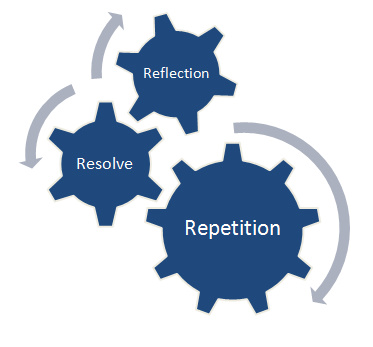
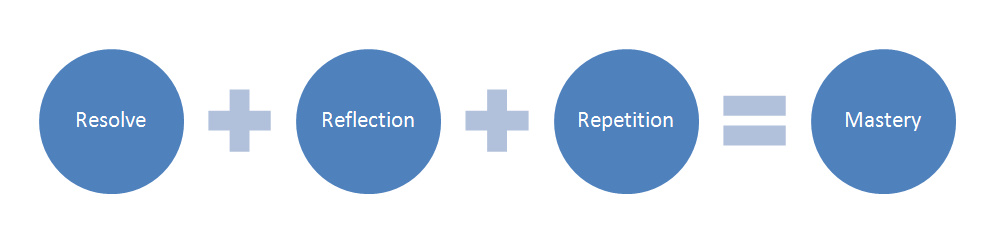
In a family, children learn not only how to read and write, and how to hold a fork and knife; here they learn how to be human. The power of this process is that it happens continually in the context of relationships regardless of the degree to which parents embrace and attend to this responsibility. Its force is evident in three gears, each with its own mechanical advantage:

Repetition: We are what we repeatedly do. A child’s experience of normal in the early years naturally and inevitably becomes the standard by which they judge all other experience. What parents present to them as good and bad, worthy and unworthy, likewise inevitably defines their norms.

Resolve: We choose one thing instead of another, and these choices have consequences. For example, parents can choose to read with their children, or choose to put them in front of a television. From these daily decisions, children learn what it is to be human.

Reflection: Socrates famously stated, “The unexamined life is not worth living.” My repeated actions always represent what I value. But do they embody what I want to value? Where do I need to break out of a rut, or establish a new routine that will be good for my family? Reflective resolve, used repeatedly, will produce a decidedly different outcome.

Reflection: The unexamined life is not worth living

Socrates famously stated, “The unexamined life is not worth living.” And yet, the unexamined life is still lived. We can reflect on the relative value of different activities and resolve to make repeated change. The power of reflection is vividly evident in the practice of athletes. It is possible by the force of great resolve and faithful repetition to train for a marathon. The person who sets a running schedule – and adheres to it – can prepare for a race she has never run in her life. And yet, if she does not reflect on her training, her resolved repetition may only serve to establish bad habits. Great runners reflect on their stride. Are they running on their heels? Are they altering their gait as they descend hills? This discipline of reflection is essential to learning to run well. If the unexamined life is not worth living, neither is the unexamined race worth running.

Reflective parenting is the discipline of asking those difficult questions. My repeated actions always represent what I value. But do they embody what I want to value? Where do I need to break out of a rut, or establish a new routine that will be good for my family? One of the most valuable questions for parents is whether a particular approach to parenting achieves its desired outcome. Some parents, desiring their children to clearly understand right and wrong, are harsh in correcting an inappropriate action. Their intentions are quite honorable: they want kids who know and choose what is right. But their actions, sadly, can have quite the opposite effect. If a father yells, “Don’t lie to me!” does it promote honest confession and repentance?  If the same father calmly but firmly asks, “Is that the truth?” is the child more or less likely to admit his fault? Taking time to reflect on the practice of parenting makes all the difference in the world. The resolve may be identical. The reflective resolve, used repeatedly, will produce a decidedly different outcome.

Repetition: We are what we repeatedly do

We are what we repeatedly do. Even if no thought is given to the art of parenting, children learn by experience a way of being in the world. Their experience of normal in the early years naturally and inevitably becomes the standard by which they judge all other experience. What parents present to them as good and bad, worthy and unworthy, likewise inevitably defines their norms.

Perhaps the most poignant example is the family meal. Does a family eat together on a regular basis? If so, what happens? Do they watch television together? Or do they have a conversation? Do they listen to one another, or is everyone talking at once? Around this table, or this television (as the case may be), children learn how to interact with other people through repeated experiences. If it is objected that watching television together isn’t interaction, and doesn’t teach interaction, they’ve missed the central point. Any repeated experience, whatever it is, establishes a child’s sense of norms and normal. For some, the focal point of that interaction may be a screen, instead of another person; and this will have significant repercussions.