Do the choices of well-educated parents affect the acheivement gap?

It (almost) goes without saying that the choices of poorly educated children have a profound influence on the achievement gap. But do the choices of well-educated parents play any role in the achievement gap? Yes, they do.

Veritas RiffIn a recent podcast interview with Ruth Lopez Turley, Associate Professor of Sociology at Rice University, the Veritas Riff explored exactly that question. The seven minute interview is worthwhile and helpful. In addition, here are some important dynamics not covered in the interview.

  1. Prizing academic achievement above community flourishing is passed from parents to children. Children learn from the lived decisions of their parents what is most important to them.
  2. Parent networks really matter in diverse schools. My eldest daughter has attended two very racially and economically diverse schools. And I can say unequivocally that parent involvement (by educated, creative, entrepreneurial parents) created the tipping point in both schools toward a thriving learning environment for all.
  3. Cultural competence is learned by practice. Children (like mine) in diverse schools learn cultural competence by doing it on a daily basis. In addition to Caucasian, Latino and African American children, my daughter’s classmates from China, Mexico, Togo, Thailand, and Bolivia. Can it make some learning dynamics more challenging? Sure. Do the benefits outweigh the challenges? Without question.
  4. Schools are not the biggest factor in education. The choice of educated parents to invest in diverse skill has a profound impact on those schools. However, it must be noted that classroom education is only one dimension of education. The total learning environment of children matters immensely – the impact of home life and community cannot be overstated.
    1. Early home life matters most. Here’s the rub. If you have diverse schools – in which some children have had a language-rich, supportive home environment, whereas others have had a hostile or neglectful home environment, the achievement gap already exists the day they walk into preschool. All of the children will receive the benefits I’ve listed above, and those Dr. Turley highlights in her interview. But some will have greater capacity to receive – and therefore the gap will persist – as it has at my daughter’ schools. The inter-racial, inter-cultural intermingling must happen long before school begins.
 

The power of universities

Recently I read my nine-year-old a biography of John Stott. (In 2005, he was named by Time Magazine as one of the 100 most influential people in the world.) Stott’s biographer, Julia Cameron, emphasized Stott’s life-long commitment to university students with these words:

[University] Students will soon become schoolteachers, doctors, lawyers, lecturers, writers, and journalists. Some will go on to serve in government. All these people influence the way others think. To change a nation, you have to begin in the universities. (p104)

This is true, and Dr. Stott placed wise and persevering effort on universities. But to truly change a nation, you have to begin in the family in the earliest years of life because those formative years are the most powerful predictor of whether a child will enter university. If you wait until university, the underclasses will always be underrepresented, and nations will not change. Indeed by waiting until university, the educational class system becomes even more entrenched.

Given the cultural power that universities (and especially elite universities) have, that is probably the point at which students must learn the inordinate cultural power of the family in the earliest years of life. If this is done, both the power of the university and the power of early formation in the family are employed for the common good.

Character, Competence, Creativity & Collaboration

Parents exert singular influence on their children’s development during the earliest years of life in four key areas:

  1. Character. The most significant role of early nurture is to form the character of children. How people treat one another is the very foundation of a just society – the kind of place in which the following three traits flourish. Without the baseline of a just society – which begins in a just family – the other aims of nurture (competence, creativity, and collaboration) can be used in ways that destroy communities rather than building them.
  2. Competence. After virtue, competence is paramount to the flourishing individuals and relationships. In fact, character and competence cannot be separated. A person cannot be virtuous without demonstrating hard work, integrity, and persistence – qualities that begin to form around age 1 when a child can learn to put his toys away.
  3. Creativity. Competence and creativity, too, are intertwined. To be competent in anything implies a measure of creativity and problem solving. In a home where creativity and innovation are intentionally cherished, children solve problems in new ways and develop life-long patterns of innovation. 
  4. Collaboration. A team is more than the sum of its parts; and children learn to work in teams (with parents and siblings!) from their earliest years. Together families that are marked by character, competence and creativity create the kind of environment where everyone wants to be.

Resolve: Human beings make purposeful decisions

Every human being makes purposeful decisions. We choose one thing instead of another, and these choices have consequences. For example, parents can choose to read with their children, or choose to put them in front of a television. This choice has significant consequences for a child in learning to be human. In the context of a shared book, a child learns to communicate by interpreting words, gestures and body language from the reader, and expressing himself in words (if he is old enough to speak), and through his own gestures and body language.

In addition to learning to interact with others, he is being initiated into a way of being in the world. If reading a book together is an isolated encounter, the impact is not nearly so great as if it is repeated; hence the primacy of repetition. Both the single encounter and the repeated practice of reading books are part of initiation. Each communicates something about the value of literature, words and interpersonal communication; resolved repetition shows that we deliberately cherish something.

Normal & Normative

Normal
Every person’s sense of normal is shaped by repeated experience. The earliest years of life play a singular role in establishing a child’s sense of normal. For one child, yelling and aggression are the normal experience of home life; for another respectful dialogue and negotiation are normal. Whatever is normal for a child profoundly affects how she perceives other ways of life. The child accustomed to aggression will be baffled by kind but firm words, just as the child  whose parents speak respectfully will be shocked by those who use name-calling or manipulation.

Normative
A child learns norms in the course of repeated early experiences. Not only does a child learn what to expect; in the earliest years she learns what is expected – or normative – behavior. A child in one home learns that telling lies is wrong, and he must not do it; another child learns that telling lies is only unacceptable if you get caught. Of course, like a child’s sense of normal, what is normative is learned as much or more from experience as from direct instruction. The child who hears his mom tell a lie talking on the phone will naturally see this as normative behavior, even if she never says anything about truth telling.

Initiation, Indoctrination and Indwelling

Initiation
Early childhood is the initiation of a child into a way of being in the world. All of a child’s early experiences teach him how to navigate the social context into which he is born. For example, Martin Luther King Jr. was well prepared by family nurture to acknowledge and address the injustices of his time.

Indoctrination
The process of initiation is also one of indoctrination, not in the pejorative sense of brainwashing, but in the old, historic definition: “to instruct especially in the fundamentals or rudiments,” or, more simply, “to teach.” In the earliest years, children learn the fundamentals of how to be human.

Indwelling
Every child is born into the story of a family and community. She becomes a character in a living story, and thus indwells a story – as Ruby Bridges did from an early age in the struggle for civil rights.

Repetition, Resolve & Reflection

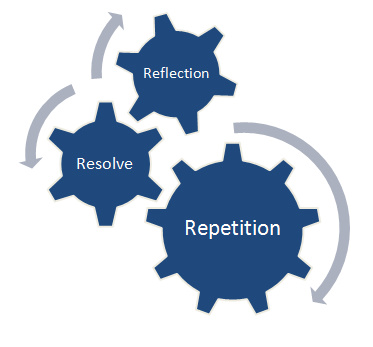
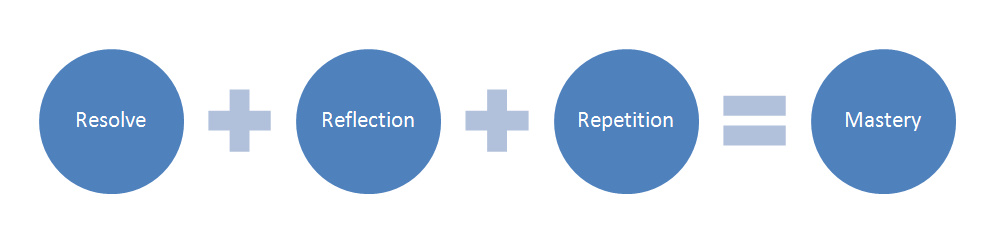
In a family, children learn not only how to read and write, and how to hold a fork and knife; here they learn how to be human. The power of this process is that it happens continually in the context of relationships regardless of the degree to which parents embrace and attend to this responsibility. Its force is evident in three gears, each with its own mechanical advantage:

Repetition: We are what we repeatedly do. A child’s experience of normal in the early years naturally and inevitably becomes the standard by which they judge all other experience. What parents present to them as good and bad, worthy and unworthy, likewise inevitably defines their norms.

Resolve: We choose one thing instead of another, and these choices have consequences. For example, parents can choose to read with their children, or choose to put them in front of a television. From these daily decisions, children learn what it is to be human.

Reflection: Socrates famously stated, “The unexamined life is not worth living.” My repeated actions always represent what I value. But do they embody what I want to value? Where do I need to break out of a rut, or establish a new routine that will be good for my family? Reflective resolve, used repeatedly, will produce a decidedly different outcome.

Reflection: The unexamined life is not worth living

Socrates famously stated, “The unexamined life is not worth living.” And yet, the unexamined life is still lived. We can reflect on the relative value of different activities and resolve to make repeated change. The power of reflection is vividly evident in the practice of athletes. It is possible by the force of great resolve and faithful repetition to train for a marathon. The person who sets a running schedule – and adheres to it – can prepare for a race she has never run in her life. And yet, if she does not reflect on her training, her resolved repetition may only serve to establish bad habits. Great runners reflect on their stride. Are they running on their heels? Are they altering their gait as they descend hills? This discipline of reflection is essential to learning to run well. If the unexamined life is not worth living, neither is the unexamined race worth running.

Reflective parenting is the discipline of asking those difficult questions. My repeated actions always represent what I value. But do they embody what I want to value? Where do I need to break out of a rut, or establish a new routine that will be good for my family? One of the most valuable questions for parents is whether a particular approach to parenting achieves its desired outcome. Some parents, desiring their children to clearly understand right and wrong, are harsh in correcting an inappropriate action. Their intentions are quite honorable: they want kids who know and choose what is right. But their actions, sadly, can have quite the opposite effect. If a father yells, “Don’t lie to me!” does it promote honest confession and repentance?  If the same father calmly but firmly asks, “Is that the truth?” is the child more or less likely to admit his fault? Taking time to reflect on the practice of parenting makes all the difference in the world. The resolve may be identical. The reflective resolve, used repeatedly, will produce a decidedly different outcome.

Repetition: We are what we repeatedly do

We are what we repeatedly do. Even if no thought is given to the art of parenting, children learn by experience a way of being in the world. Their experience of normal in the early years naturally and inevitably becomes the standard by which they judge all other experience. What parents present to them as good and bad, worthy and unworthy, likewise inevitably defines their norms.

Perhaps the most poignant example is the family meal. Does a family eat together on a regular basis? If so, what happens? Do they watch television together? Or do they have a conversation? Do they listen to one another, or is everyone talking at once? Around this table, or this television (as the case may be), children learn how to interact with other people through repeated experiences. If it is objected that watching television together isn’t interaction, and doesn’t teach interaction, they’ve missed the central point. Any repeated experience, whatever it is, establishes a child’s sense of norms and normal. For some, the focal point of that interaction may be a screen, instead of another person; and this will have significant repercussions.

The Apprenticeship of Being Human

Early childhood is the apprenticeship of being human. Like the apprenticeship of an artist, it is composed of both explicit instruction and continual modeling within a personal relationship. The disproportionate influence of these early years lies in the fact that apprenticeship occurs constantly in children’s most primary relationships during a period of unparalleled brain growth that has a lifelong impact on a child’s character, competence, creativity, health and ability to collaborate. For better or for worse, the family is the studio in which children begin the apprenticeship of being human.