Compelling Early Childhood Numbers

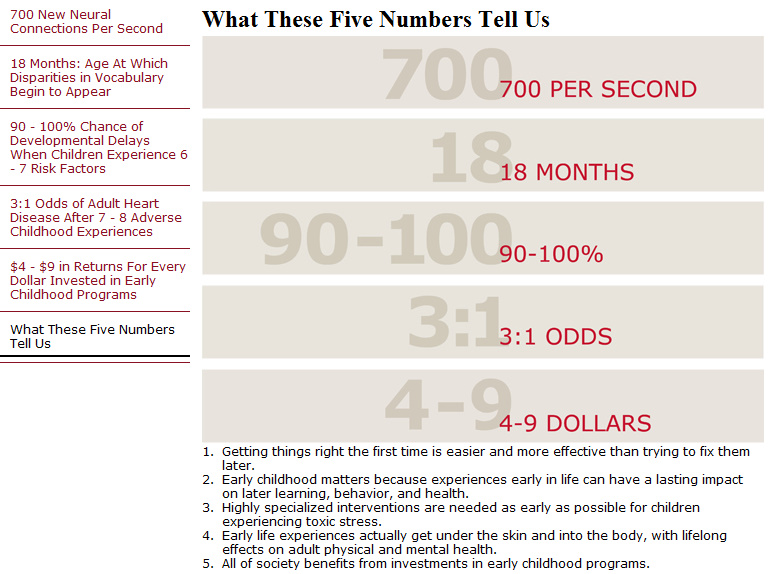
Once again, the Center on the Developing Child at Harvard has provided a great resource for those seeking to understand early childhood. They offer Five Numbers to Remember About Early Childhood Development that are simple, clear and compelling.

The numbers capture well many the most salient numbers:

  1. Rate of Brain Development
  2. Age when Disparities Appear
  3. Impact of Risk Factors
  4. Return on Investment

These are compelling numbers to anyone who cares about health, education, stewardship or civil society.

Early Experiences Alter Gene Expression

The nature vs. nurture argument has long captured the minds of those who care about child development. Which matters more: genetics, or a child’s early environment?

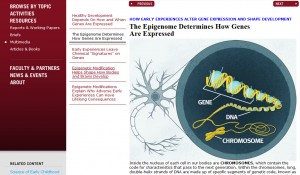
According to Center on the Developing Child at Harvard University, nurture is key. Early experiences alter gene expression and shape development. In an interactive feature on their website, they tell the story of human development and how early experiences leave chemical “signatures” on the genes, which determines whether and how the genes are expressed.

In other words, even with good genes, early experiences can alter the expression of those genes – particularly the ones that affect brain development – in damaging ways. Consequently, “experiences that change the epigenome early in life, when the specialized cells of organs such as the brain, heart, or kidneys are first developing, can have a powerful impact on physical and mental health for a lifetime.”

The question is not nature or nurture. It is how can we support early nurture?

Is Failure the Key to Success?

Paul Tough’s recent cover story in the New York Times Magazine titled What if the Key to Success is Failure? makes a strong case for the importance of character in education. With masterful style, he tells how two educational leaders  of very different schools have collaborated to help their students develop character.

The article has rightly garnered attention and reaction from major news outlets and influential thinkers. Tough has touched a nerve. He has put into words what others feel.

Paul Tough is the author of Whatever it Takes: Geoffrey Canada’s Quest to Change Harlem and America. The brilliance of that book is the second chapter: Unequal Childhoods (although the whole book is fantastic). In Unequal Childhoods he chronicles the importance of what happens in the home long before children enter school. And he wisely recognizes that perhaps the cornerstone and linchpin of the Harlem Children’s Zone’s success is its Baby College with engages and empowers parents from before birth.

Here is the pressing question: If the earliest years are so critical for brain building that the achievement gap exist long before children enter school, is it possible that the same is true of character? Could it be that a child’s character is significantly formed in this period? Could it be that the formation of character in the earliest years is at the very heart of the education crisis?

How to get washboard abs – or a gut

Has it ever occurred to you that you get washboard abs the same way you get a gut?

Both are attained by practice. What you do repeatedly affects the shape of your body – whether arduous ab workouts, or consuming more calories than your body needs.

What does this have to do with parenting?

It is commonly assumed that practice is the pathway to excellence. It is. But it is also the path to mediocrity and failure. What you practice, and how you practice determine which path you’re on.

Many young children are on the path to having a gut before they even lose their baby teeth. They’re practicing a pattern of nutrition and exercise that will result in obesity in all but a few children. Parents (or those who act in their stead) are the chief influences of early childhood nutrition and exercise. We are the ones who establish patterns of practice – patterns which can lead to health or disease.

Recommended Reading

On Urban Education

On the Harlem Children’s Zone: Whatever it Takes, Geoffrey Canada’s Quest to Change Harlem and America. Paul Tough’s second chapter, Unequal Childhoods is a succinct statement of why parent engagement in early childhood has formed the cornerstone of the HCZ.

Geoffrey Canada on himself: Fist, Stick, Knife, Gun: A Personal History of Violence in America. Canada’s candid memoir is a vivid firsthand perspective on the the influence of parents (or their absence) growing up in the South Bronx.

The NY Times on Roland Fryer: Toward a Unified Theory of Black America. Stephen J. Dubner provides a fascinating peek into the personal history, talents, and passions of one of the world’s brightest young economists.

Former US Assistant Education Secretary on Educational Reform: Changing the Odds for Children at Risk:Seven Essential Principles of Educational Programs That Break the Cycle of Poverty. Susan B. Neuman examines the key levers of real educational reform.

On Stories:

Gladys Hunt on children’s literature:Honey for a Child’s Heart: The Imaginative Use of Books in Family Life. Gladys connects the dots between great stories and the way children learn to make sense of the world around them.

Robert Coles on stories: The Call of Stories: Teaching and the Moral Imagination. Pediatric psychiatrist and Harvard professor Robert Coles shares his journey into literature through the poems of physician William Carlos Williams – and of his own journey through literature in teaching graduate students in many disciplines.

Why marriage matters

Why Marriage Matters with Kay Hymowitz
(Click on the link to play the audio in your browser using QuickTime, or “Ctrl”+ click and “save as” to download and listen later.)

The author of Marriage and Caste in America discusses the need for cultural renewal through the family. Hymowitz explores the social implications of the disproportionate decay of marriage in some social groups.

Practice makes (almost) permanent

The adage goes: Practice makes perfect. That’s true, if you’re practicing the right skill in the right way. More accurately, Practice makes any habit (almost) permanent. Practice can make a flawed habit just a deeply ingrained as a perfect habit.

If you meet an adult who, since early childhood has held forks and spoons in a fist (rather than with three fingers in a pencil-like grip) and ask him to hold his utensils in a standard way, it will feel awkward and difficult to adopt the new hold because years of practice has made his fist-grasp feel normal.

Manners of speech are little different. If you meet an adult who has a verbal habit of using ums and ahs to connect parts of speech, and ask her to speak without those audible pauses, it will feel to her like learning how to speak all over again. By constant practice, she has trained herself to use those sounds without ever thinking about it.

In virtually everything we do, practice makes almost permanent. For this reason, learning early to hold a fork in a particular way, or to speak without ums and ahs pays dividends for years to come. Practice can make perfect, but only if it is practicing a valuable activity with thoughtfulness and excellence.