Video: Early Family Experiences Shape Later Success

“There is strong biological evidence, strong neuroscientific evidence that suggest that early family conditions are powerful in shaping cognitive and non-cognitive skills, and that those determine – to a degree that we didn’t realize before – the later success of a person.”

It is for this reason that Nobel Prize winning economist James Heckman lobbies for investment not just in early childhood programs – but in families with young children.

httpv://youtu.be/NCeOBd4Simo

Resolve: Human beings make purposeful decisions

Every human being makes purposeful decisions. We choose one thing instead of another, and these choices have consequences. For example, parents can choose to read with their children, or choose to put them in front of a television. This choice has significant consequences for a child in learning to be human. In the context of a shared book, a child learns to communicate by interpreting words, gestures and body language from the reader, and expressing himself in words (if he is old enough to speak), and through his own gestures and body language.

In addition to learning to interact with others, he is being initiated into a way of being in the world. If reading a book together is an isolated encounter, the impact is not nearly so great as if it is repeated; hence the primacy of repetition. Both the single encounter and the repeated practice of reading books are part of initiation. Each communicates something about the value of literature, words and interpersonal communication; resolved repetition shows that we deliberately cherish something.

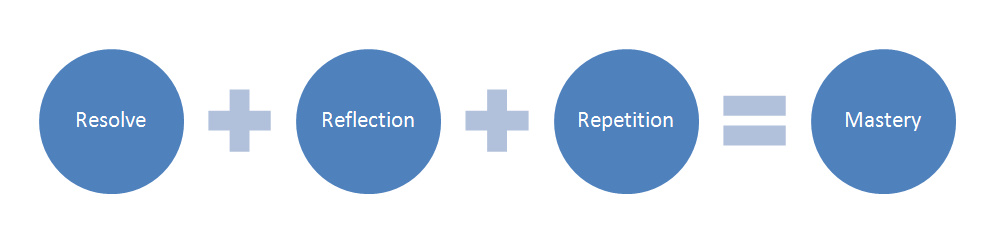
Repetition, Resolve & Reflection

In a family, children learn not only how to read and write, and how to hold a fork and knife; here they learn how to be human. The power of this process is that it happens continually in the context of relationships regardless of the degree to which parents embrace and attend to this responsibility. Its force is evident in three gears, each with its own mechanical advantage:
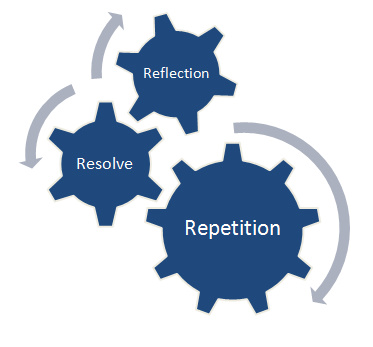
Repetition: We are what we repeatedly do. A child’s experience of normal in the early years naturally and inevitably becomes the standard by which they judge all other experience. What parents present to them as good and bad, worthy and unworthy, likewise inevitably defines their norms.

Resolve: We choose one thing instead of another, and these choices have consequences. For example, parents can choose to read with their children, or choose to put them in front of a television. From these daily decisions, children learn what it is to be human.

Reflection: Socrates famously stated, “The unexamined life is not worth living.” My repeated actions always represent what I value. But do they embody what I want to value? Where do I need to break out of a rut, or establish a new routine that will be good for my family? Reflective resolve, used repeatedly, will produce a decidedly different outcome.
Repetition: We are what we repeatedly do

We are what we repeatedly do. Even if no thought is given to the art of parenting, children learn by experience a way of being in the world. Their experience of normal in the early years naturally and inevitably becomes the standard by which they judge all other experience. What parents present to them as good and bad, worthy and unworthy, likewise inevitably defines their norms.

Perhaps the most poignant example is the family meal. Does a family eat together on a regular basis? If so, what happens? Do they watch television together? Or do they have a conversation? Do they listen to one another, or is everyone talking at once? Around this table, or this television (as the case may be), children learn how to interact with other people through repeated experiences. If it is objected that watching television together isn’t interaction, and doesn’t teach interaction, they’ve missed the central point. Any repeated experience, whatever it is, establishes a child’s sense of norms and normal. For some, the focal point of that interaction may be a screen, instead of another person; and this will have significant repercussions.

Is the media to blame for social ills?

It is quite popular to blame social decay on “the media,” which glorify violence, insolence and irresponsibility. But the question must be asked: Who are the gatekeepers of media? Who chooses what books to read, which magazines to browse, which channels to watch, what movies to see, and what websites to surf? The answer, of course, is parents.

When parents abdicate this responsibility of selecting, embracing and celebrating the good, true and beautiful through these diverse media, then toxic waste can and does flow through these channels into the homes and lives of young children. That this happens when parents abdicate their responsibility is itself a demonstration that the responsibility belongs to them, and that they wield unmatched influence on the nurture of their children.