Strong families, Strong Communities, Strong Nation

Last night in the State of the Union address, President Obama highlighted the critical importance of early childhood for the well-being of children, their families, communities and the nation.

“Study after study shows that the sooner a child begins learning, the better he or she does down the road.”

It isn’t when a child begins learning, but how and what he or she learns. Learning begins before birth regardless of the choices parents make. What a mother eats and drinks (and smokes) while pregnant affects a child’s learning capacities. From their first moment out of the womb, all children are immersed into a learning environment. The emotional attachment that children form (or fail to form) to their parents in the first year of life has a lifelong effect on learning. The tone and number of words that they hear in the first three years of life furnish them with the tools with which to explore the world.

In short, the President’s call to make preschool available to all children is laudable. Preschool really can be a wonderful learning environment for children. But the really great gains are made in interventions with families (not just children) even earlier in life. After all, without intervention to support parents, preschool is not prevention; it is remediation.

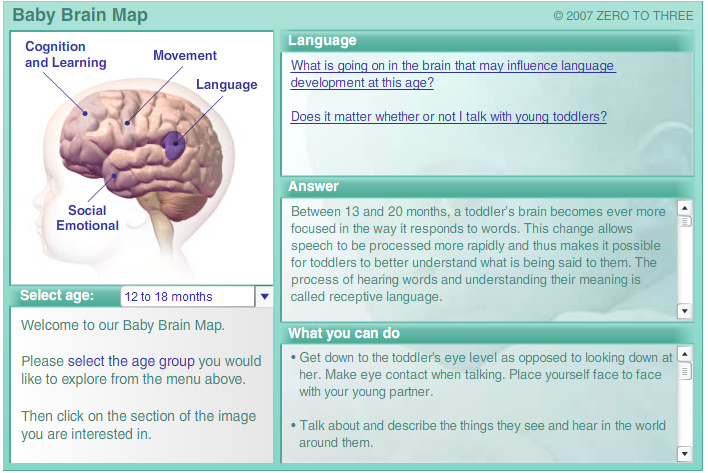
Childhood adversity and brain development

There is a growing literature showing that the early experiences of children shape their brain architecture. Two days ago an article in Frontiers in Human Neuroscience added to that literature.

Kids who come from lower socioeconomic families have a harder time ignoring insignificant environmental information than children who come from higher income families, due to the fact that they learn how to pay attention to things differently . . . (from the press release)

The sample size of the study is very small (28 students), and so one can’t put too much weight on it. However, it does suggest that environmental factors in early childhood affect the way that we process information. Specifically:

“These results indicate that children from lower socioeconomic status have to exercise more cognitive control in order to ignore unimportant information than children of higher socioeconomic status.”

Now the question is whether socioeconomic status is the critical variable. Poor children are four times more likely to live in a father-absent home. Is it possible that certain types of home environments not only correlate with poverty, but in fact perpetuate it by their effect on children’s brain development?

Compelling Early Childhood Numbers

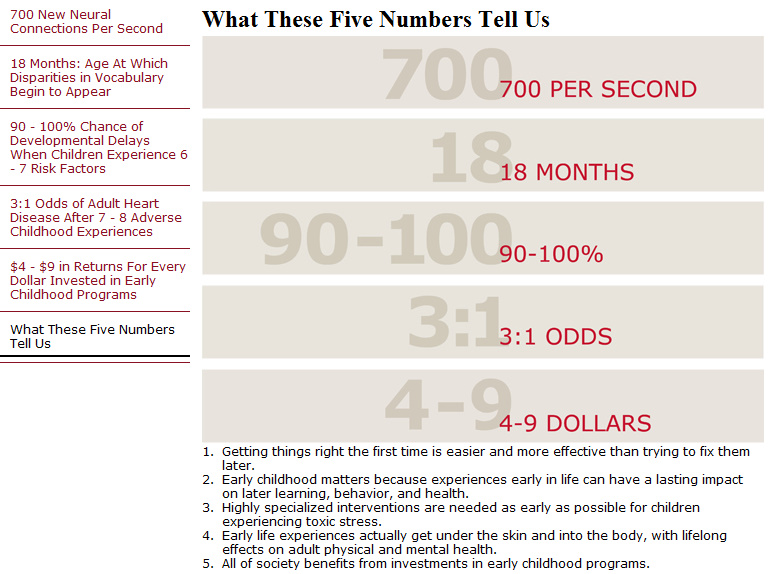
Once again, the Center on the Developing Child at Harvard has provided a great resource for those seeking to understand early childhood. They offer Five Numbers to Remember About Early Childhood Development that are simple, clear and compelling.

The numbers capture well many the most salient numbers:

  1. Rate of Brain Development
  2. Age when Disparities Appear
  3. Impact of Risk Factors
  4. Return on Investment

These are compelling numbers to anyone who cares about health, education, stewardship or civil society.

Early Experiences Alter Gene Expression

The nature vs. nurture argument has long captured the minds of those who care about child development. Which matters more: genetics, or a child’s early environment?

According to Center on the Developing Child at Harvard University, nurture is key. Early experiences alter gene expression and shape development. In an interactive feature on their website, they tell the story of human development and how early experiences leave chemical “signatures” on the genes, which determines whether and how the genes are expressed.

In other words, even with good genes, early experiences can alter the expression of those genes – particularly the ones that affect brain development – in damaging ways. Consequently, “experiences that change the epigenome early in life, when the specialized cells of organs such as the brain, heart, or kidneys are first developing, can have a powerful impact on physical and mental health for a lifetime.”

The question is not nature or nurture. It is how can we support early nurture?

Serve and Return Interaction Shapes Brain Circuitry

The Harvard Center on the Developing Child has produced a simple video that shows why parent interaction is so critical to early brain development.

httpv://youtu.be/m_5u8-QSh6A

“Ensuring that children have adult care givers who consistently engage in serve and return interaction, beginning in infancy, builds a foundation in the brain for all the learning, behavior and health that follow.”