Illegitimacy: The New Normal

Aside

The New York Times has noted that normal has changed. According to a report from Child Trends, more than half of children born to women under age 30 are born outside of marriage. The article begins: “It used to be called illegitimacy. Now it is the new normal.”

Not just “normal”, but new norms

What has changed is not simply the prevalence of children born apart from marriage, but the norms on which the institution of marriage was grounded. The reason that illegitimacy is no longer used is that it belongs to a time when marriage was not only normal, it was normative for procreation.

If you read the Times  article as an anthropologist, you will be struck by the way that norms have changed over the period of time that has experienced such an explosion of children born apart from marriage. Yes, of course, marriage as a social norm has decayed. But to focus on that is to miss the forest for the trees. What is taken as normative by the journalists – and many if not most of their readers – is that individual and social behavior ought to be explained by efficient causes: changes in the social milieu (e.g. “Liberal analysts argue that shrinking paychecks have thinned the ranks of marriageable men”) and public policy (e.g. “conservatives often say that the sexual revolution reduced the incentive to wed and that safety net programs discourage marriage”). It is now both normal and normative in public discourse to address – and attempt to resolve – social issues exclusively in terms of efficient causes.

The Compounding Effect
My generation is a unique one because we can remember a time when public discourse was not merely in terms of cause and effect, but of right and wrong. Dr. King’s letter from a Birmingham Jail argued powerfully for obedience to just laws and loving disobedience to unjust ones not because such actions were likely to produce desirable outcomes (Dr. King was writing from jail), but because the justice or injustice of a law was measured by its harmony with the moral law, or the law of God. Our children’s generation is in a profoundly different position because their experience of the use of language NOW establishes what they experience as normal and normative. If they listen to us, they stand in danger of seeing marriage merely as a social convention among some subcultures that is merely the product of social, political, and historical (efficient) causes and without any sort of relationship to a moral law or law of God.

Manipulation or Moral Courage
Being born out of marriage is the new normal (at least for children born to women under 30). That’s true whether we like it or not. The question now is how we will respond. Will we try to manipulate the levers of society (public policy, social factors, etc.)? Will we argue about what carrots and what sticks to use to manipulate others into behaviors we desire? Will we blame one another and accidents of history for the state of society?

Or will we have the moral courage to transgress the new norms of language? Rather than blaming others, or impersonal causes, or “social conditions,” will we have courage to take responsibility and confess our own culpability? Will we have the love and patience to come alongside shattered children, mothers and fathers? On what grounds will we call them to something better? Will we recognize that we and they are responsible moral agents who act within the web of real and powerful social settings which do not sufficiently explain our actions? Will we act against social, political, and historical forces for something that is more good, true and beautiful?

Our children are watching and listening.
Normal & Normative

Normal
Every person’s sense of normal is shaped by repeated experience. The earliest years of life play a singular role in establishing a child’s sense of normal. For one child, yelling and aggression are the normal experience of home life; for another respectful dialogue and negotiation are normal. Whatever is normal for a child profoundly affects how she perceives other ways of life. The child accustomed to aggression will be baffled by kind but firm words, just as the child  whose parents speak respectfully will be shocked by those who use name-calling or manipulation.

Normative
A child learns norms in the course of repeated early experiences. Not only does a child learn what to expect; in the earliest years she learns what is expected – or normative – behavior. A child in one home learns that telling lies is wrong, and he must not do it; another child learns that telling lies is only unacceptable if you get caught. Of course, like a child’s sense of normal, what is normative is learned as much or more from experience as from direct instruction. The child who hears his mom tell a lie talking on the phone will naturally see this as normative behavior, even if she never says anything about truth telling.

Repetition, Resolve & Reflection

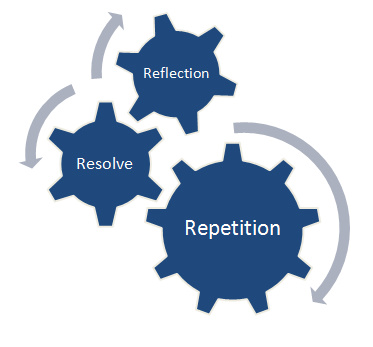
In a family, children learn not only how to read and write, and how to hold a fork and knife; here they learn how to be human. The power of this process is that it happens continually in the context of relationships regardless of the degree to which parents embrace and attend to this responsibility. Its force is evident in three gears, each with its own mechanical advantage:

Repetition: We are what we repeatedly do. A child’s experience of normal in the early years naturally and inevitably becomes the standard by which they judge all other experience. What parents present to them as good and bad, worthy and unworthy, likewise inevitably defines their norms.

Resolve: We choose one thing instead of another, and these choices have consequences. For example, parents can choose to read with their children, or choose to put them in front of a television. From these daily decisions, children learn what it is to be human.

Reflection: Socrates famously stated, “The unexamined life is not worth living.” My repeated actions always represent what I value. But do they embody what I want to value? Where do I need to break out of a rut, or establish a new routine that will be good for my family? Reflective resolve, used repeatedly, will produce a decidedly different outcome.

Repetition: We are what we repeatedly do

We are what we repeatedly do. Even if no thought is given to the art of parenting, children learn by experience a way of being in the world. Their experience of normal in the early years naturally and inevitably becomes the standard by which they judge all other experience. What parents present to them as good and bad, worthy and unworthy, likewise inevitably defines their norms.

Perhaps the most poignant example is the family meal. Does a family eat together on a regular basis? If so, what happens? Do they watch television together? Or do they have a conversation? Do they listen to one another, or is everyone talking at once? Around this table, or this television (as the case may be), children learn how to interact with other people through repeated experiences. If it is objected that watching television together isn’t interaction, and doesn’t teach interaction, they’ve missed the central point. Any repeated experience, whatever it is, establishes a child’s sense of norms and normal. For some, the focal point of that interaction may be a screen, instead of another person; and this will have significant repercussions.