There is no lack of parenting books. They hit the top of the best seller lists:


Given the abundance of parenting books, why write yet another book on parenting?
The Apprenticeship of Being Human is not a method. Rather, it explains why parenting practices matter, and therefore provides a framework for understanding and sifting through the ever-burgeoning parenting section of bookstores and libraries. It does so by providing a generative metaphor for why a child’s early experiences have such profound and long-lasting effects in all of life.
The disproportionate influence of the first five years of life lies in the fact that apprenticeship occurs constantly in children’s most primary relationships during a period of unparalleled brain growth and plasticity, forming up to 2 million synapses per second. A child’s brain grows from 25% to 80% of its adult volume from birth to age 3, and to 90% by age 5. If a child grew in stature at the same rate, the prototypical American boy would be five feet two and half inches tall by his fifth birthday.
Early childhood brain development is both rapid AND sensitive. 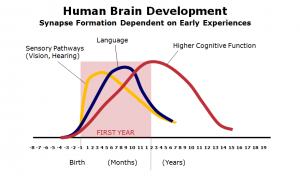
What happens (or does not happen) in those early years shapes the physical structure of the child’s brain, defines the child’s understanding of normal and normative, and molds the child’s posture toward the world. Collectively, repeated early experiences have a lifelong impact on a child’s character, competence, creativity, health, and ability to collaborate with others. That is why early childhood parenting matters to everyone.
Pingback: 4/14 Family Challenge Conference: ‘Passing on the Faith to Your Children | Tri-State Voice